Core laboratory testing requires speed, precision, and operational resilience. Anasys builds a unified analytical environment where Clinical Chemistry Analyzers and Immunoassay Systems operate as a single, track connected platform. This setup streamlines the entire testing continuum, supporting Chemistry Reagents, Immunoassay Reagents, Electrolyte Reagents, and ELISA applications. Automated integrity checks, reflex logic, and intelligent inventory control reduce manual steps and deliver fast, reliable clinical data.
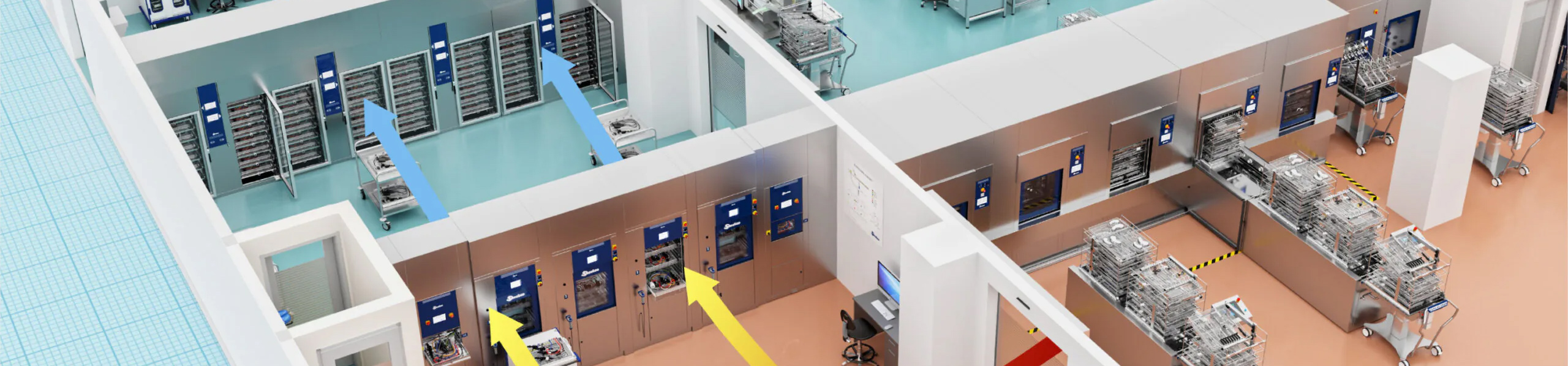
Clinical Chemistry Analyzers and Immunoassay Systems are linked by a modular transport track. A decapper and barcode station verify incoming Blood Collection Tubes before loading. STAT lanes move urgent samples to the aspiration point within 45 seconds.
The chemistry analyzer supports a full menu including hepatic, renal, lipid, and metabolic panels, with ion selective electrodes for electrolytes. The immunoassay module handles thyroid, fertility, cardiac, and tumor markers. Track software balances workload and routes assays to the fastest available module.
Stress testing validates throughput of 800 tubes per hour with carryover below 0 point 1 ppm. Dashboards display instrument status, reagent levels, and pending tests.
Technical Note: Conveyor tension must be checked monthly. ISE reagents should be gently inverted to avoid micro bubbles that affect electrode readings.
Batch assays and specialized panels run on a dedicated ELISA Readers and Washers workcell. A 96 channel washer removes unbound material, and a multi wavelength reader measures optical density. Software generates standard curves and applies lot specific adjustments.
Chemiluminescence Immunoassay capability on the main track supports high sensitivity infectious disease and cardiac assays. Refrigerated storage maintains Immunoassay Reagents at 8 C for stability.
Technical Note: The washer vacuum pump requires a hydrophobic filter. Dispense accuracy must be verified monthly; deviations above 5 percent require adjustment.
Serum index measurements for hemolysis, icterus, and lipemia are performed automatically using multi wavelength absorbance. Results exceeding interference limits can be suppressed.
Reflex rules trigger follow up tests automatically, such as adding Free T4 and Free T3 when TSH is abnormal, or repeating potassium with hemolysis check when critically high.
Automatic dilutions are performed when results exceed the analytical range, with correct dilution factors applied to final results.
Technical Note: The hemolysis threshold for potassium suppression is typically an H index of 50 mg per dL but should be validated for local populations.
Barcode and RFID tracking monitor Chemistry, Immunoassay, and Electrolyte Reagents from receipt to disposal. Each reagent is linked to lot number, expiration, and stability.
When loaded, the analyzer verifies calibration status and remaining onboard life. Predictive alerts warn when inventory will fall below par within 24 hours, triggering purchase recommendations.
Consumables such as cuvettes, sample cups, and tips are tracked with visual dashboards and refill alerts.
Technical Note: RFID requires clear line of sight; metallic labels may block signals, so barcodes serve as backup.
A QC module manages scheduling, analysis, and review across all connected analyzers. Target means and SDs are preloaded, and Westgard rules are applied in real time.
QC failures trigger immediate alerts and can lock affected tests until corrective action is completed. Guided troubleshooting helps identify issues such as expired reagents or calibration drift.
Monthly peer comparison reports and Levy Jennings plots support long term precision monitoring and accreditation readiness.
Technical Note: QC material must be aliquoted into single use vials. Repeated freeze thaw cycles cause variability and false QC failures.
Subscribe to access specialized product classifications and tailored laboratory solutions. Enhance your operational efficiency with our systematic intelligence.
© Nortek HealthCare Group Ltd., 2009-2026. All rights reserved.
This site operates under the laws of the People's Republic of China. Your access and use constitute acceptance of these Terms of Use and our Privacy Policy. All content is governed by our Privacy Notice. For details or inquiries, please Contact Us or use the site's search function.